Introduction: Highly porous polymers with well-defined morphologies can be prepared by the emulsion templating process[1]. The process, whereby the continuous phase of a high internal phase emulsion (HIPE) is polymerized, results in materials referred to as polyHIPEs. Recent developments in the photo-initiated polymerization of HIPEs have allowed for the preparation of polyHIPE polymers from monomers which form highly unstable emulsions, such as multifunctional thiol and alkene (typically acrylate) monomers[2]. PolyHIPEs prepared from a trifunctional thiol and polycaprolactone-triacrylate (PCL-TA) have been shown to be biodegradable, and biocompatible in initial cell culture studies[3].
Experimental Methods: Biodegradable polyHIPEs were prepared by radically initiated network formation between combinations of a trifuntional thiol, and PCL-TA (Figure 1). Example procedure: The HIPE oil phase, consisting of a trithiol (0.6 g), PCL-TA (2.0 g), solvent (4 ml), surfactant (3 wt% of organic phase), and photoinitiator (7 wt% of monomer content) were combined in a 2-neck round bottom flask with continuous stirring at 350 rpm from an overhead stirrer fitted with a D shaped PTFE paddle. Water (90 wt% of total emulsion) was added dropwise to form the HIPE. The HIPE was then poured into a mould and cured by passing under a UV lamp. The resulting polyHIPE is then washed by immersion in acetone and dried under reduced pressure.
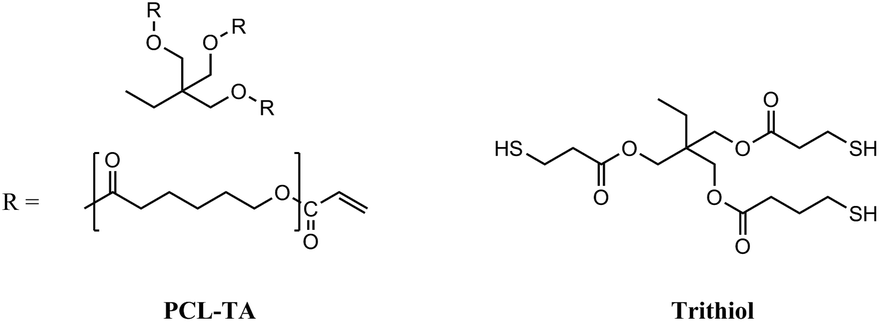
Figure 1. Crosslinkers used in the preparation of PCL-TA polyHIPEs.
Results and Discussion: A range of biodegradable polyHIPE polymers can be prepared by the described method by varying the thiol and acrylate monomers used. An example of the polymer morphology obtained is shown in Figure 2.

Figure 2. SEM image of thiol-PCL polyHIPE. Scale bar = 500 µm.
The open, interconnected morphology observed in Figure 2 allows for cell penetration into the porous polymer, although cell growth is mainly observed at the surface (Figure 3). The successful culture of a fibroblast cell line (L929) on PCL-TA polyHIPEs for periods of up to 7 days (Figure 3) indicates that the polyHIPEs are biocompatible.

Figure 3. a) MTT assay of cultured cell line on PCL-TA polyHIPE vs control. b, c) Micrographs of H&E stained sections of PCL-TA polyHIPE after 3 (b) and 7 (c) days of culture. Scale bar = 100 µm.
Conclusion: Porous polymers (polyHIPEs) have been prepared from trifuntional thiol and PCL-TA monomers by emulsion templating. These polymers have been shown to be biodegradable and biocompatible in initial cell culture studies.
Monash University; Support from the “Precision Polymer Materials (P2M)” RNP programme from the European Science Foundation is acknowledged. The European Commission (FP7-SME-2008-2-243542-HIP)
References:
[1] Cameron N. R., Polymer, 46:1439-1449, 2005
[2] Lovelady E., et al., Polym. Chem., 2:559-562, 2011
[3] Johnson D. W., et al., Polym. Chem., DOI: 10.1039/C5PY00721F